Thanks so much for taking the time to read this humble little blog. I am Austin Howard, currently a doctoral researcher, student and instructor at Florida State University, formerly a research assistant at the University of Leiden (Universiteit Leiden) in The Netherlands.
In addition, I am also a tea-lover, a devotee of theatre and poetry, an academic/artistic Youtuber and a work-seeking voice actor.
I read widely in the Bio-social sciences, Social sciences and Humanities. I particularly enjoy questions of cultural diffusion (how aspects of culture are spread across time and space), the evolution of human symbolic culture and how peoples organise themselves and their cultures at symbolic levels (ethnicity, sub-cultures and the like) and emotions – how they are expressed and defined by different cultures, both displaying the unity and diversity of humanity.
I recently undertook crowd-funded, independent fieldwork in the Ecuadorian Amazon, learning a great deal from members of Napo Kichwa, Pastaza Kichwa, Waorani and Achuar communities in Amazonia. There I contributed to Professor Janis Nuckoll’s ‘Quechua Real Words’ audio-visual dictionary/corpus of Kichwa ideophones (performative depictive utterances): https://quechuarealwords.byu.edu/
Ideophones were also the topic of my Master’s thesis. My MA was completed on the topic of (and with the title of) Sound Symbolism in the Turkish Tongue. This work looked at words where the meaning was allegedly contained within the sound in a non-arbitary manner (think of the English ‘crack!’ and it may become clear that the word ‘crack’ sounds a great deal like the sound of cracking itself). I gave these words in Turkish to native English-speakers who had no knowledge of the Turkish language and asked the simple question ‘Could they indicate the correct meaning of the words more than a random, ‘chance’ level? It turns out they could. Of course, there’s a lot more to the research than that, but that’s the take-home message.
I also contributed data on a Medieval Sicilian text for a larger database of Medieval descriptions of ‘ethnicities’ in Latin-language works. The database is called GENS and is a product of the Austrian Academy of Sciences (Österreichische Akademie der Wissenschaften): https://www.oeaw.ac.at/imafo/gens/scire_information.html#information My contribution was specifically passages related to ethnonyms (ethnic labels) which appeared in Geoffey Malaterra’s De rebus gestis Rogerii et Roberti Guiscardi ducis, fratris ejus (The deeds of Count Roger of Calabria and Sicily and of his brother Duke Robert Guiscard). The labels were then entered into the database along with the syntactically-linked descriptors (basically, the sentence the labels were in and perhaps a sentence either side that gave that label context).
I continue to be very interested in questions of human evolution and also of comparative anthropology and comparative primatology as well as comparative cognition and broad evolutionary sciences. One day I would like to unite my wide-reaching interests.
I also host a podcast called ‘The South America Podcast: From the Andes to the Amazon and (almost) to Antarctica where I discuss many aspects of mainly Indigenous South American cultures, history, genetics and biogeography with experts on these topics.
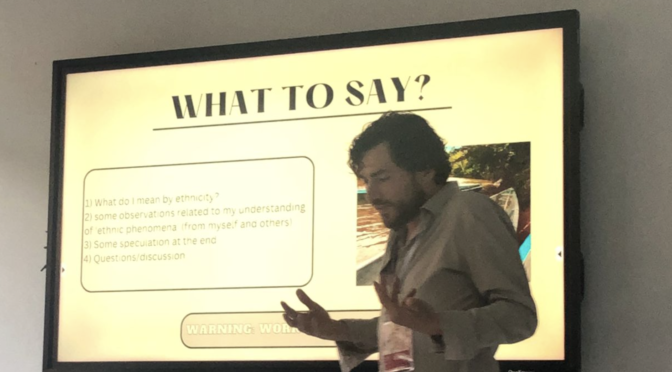
I am interested in multiple species of creature and also all parts of the globe. I have presented at many conferences on topics from Gaelic-Scandinavian interaction in Ireland to ethnic identity formation in the Amazon to the cognitive predispositions of humans to link certain sounds and meanings and how that might relate to gesture in human communication behaviour.
I am also a passionate student of languages and an advocate for a multilingual world. I write most of these posts in English, but that will be increasingly changing for the better. A global language is also, ironically, somewhat provincial, as the literary critic George Steiner once said – ‘Weltsprache ist auch Provinz.’